Public Service Project
Why This Exists
It started with a tree, a neighbor, and a political conversation that did not turn into a fight.
That alone felt almost revolutionary.
The Public Service Project did not begin in a think tank, at a political convention, or in a room full of consultants. It began in ordinary life — which is exactly where public service should begin.
Not every political idea begins as a campaign. Some begin as a conversation.
The Public Service Project began with a simple realization: people who disagree politically can still agree that government should work better.
That may sound obvious. It should be obvious. But in a culture trained to treat every difference as a war, ordinary agreement can feel almost suspicious.
This project exists because that agreement is worth protecting.
The Japanese maple story.
It began on a quiet Sunday afternoon, with a ladder, a Japanese maple tree, and one of those neighbor conversations that somehow becomes bigger than the chore.
Germany had just won a World Cup match by seven goals to one. The kind of score that makes people check twice to make sure the scoreboard is not broken.
A neighbor needed help trimming the top of a Japanese maple tree. One man climbed the ladder because he was tall enough to reach. The other held the branches and complained about politics.
One was an older Republican. The other had spent decades living in Europe, working in media, writing books, making music, acting, building businesses, and asking why government so often seems designed to frustrate the very people who pay for it.
They did not agree on everything. They didn’t have to.
What surprised both of them was how much common ground they found.
“Maybe you should run.”
The answer wasn’t yes. It wasn’t no. It was another question.
What if government stopped acting like a permanent political contest and started acting like a public service organization?
What if elected officials saw themselves as service providers instead of celebrities? What if success was measured by transparency, competence, responsiveness, and results instead of slogans and outrage?
Those questions became this project.
And yes — it all started while trimming a Japanese maple.
Why that moment mattered.
The important part was not that two neighbors solved politics under a tree. They did not. Nobody does that in one conversation, and anybody claiming they can is probably selling something.
The important part was simpler: two people with different experiences, different political instincts, and different assumptions were still able to talk about what government should do.
They could agree that public systems are often too confusing. They could agree that officials too often seem distant from the daily problems of ordinary people. They could agree that politics has become too much performance and not enough service.
Most people are not enemies. Most people are neighbors trying to solve the same problems from different experiences.
How a conversation became a civic project.
The Public Service Project grew from a few plain questions that refused to go away.
- What if government thought of citizens as clients? Not subjects. Not audiences. Not partisan data points. Clients, customers, owners, and funders of the public system.
- What if public office was treated as service work? A temporary assignment with measurable responsibilities, not a throne, celebrity platform, or lifetime career.
- What if every public service had to pass a simple usability test? Can normal people understand it, access it, afford it, and measure whether it works?
- What if competence became politically exciting? Not because it is flashy, but because it saves people time, money, stress, and humiliation.
- What if the point was repair? Not worshiping government. Not destroying government. Making government work.
What this project rejects.
The Public Service Project is not built around hating one side and cheering for the other. That game is already crowded.
Permanent Combat
Politics should not be a never-ending outrage machine that rewards conflict more than public results.
Institutional Arrogance
Government offices should not treat confusion, delay, and poor communication as the public’s problem.
Empty Slogans
A phrase is not a policy. A speech is not a service. A promise is not proof.
Political Celebrity
Public officials are not above the public. They work for the public.
Complexity as Cover
When only insiders can understand a system, accountability becomes optional.
Hopelessness
Broken systems are not natural disasters. They are designed by people, which means people can redesign them.
What this project believes.
The Public Service Project believes government should be understandable, reachable, accountable, useful, measurable, and honest about its own limits.
It believes ordinary people should not have to become experts in bureaucracy to receive basic public service.
It believes a government form, public budget, agency website, permit process, city council agenda, school board decision, or transportation plan should be judged by whether normal people can understand what is happening and how it affects their lives.
It believes disagreement is normal. It believes permanent dehumanization is not.
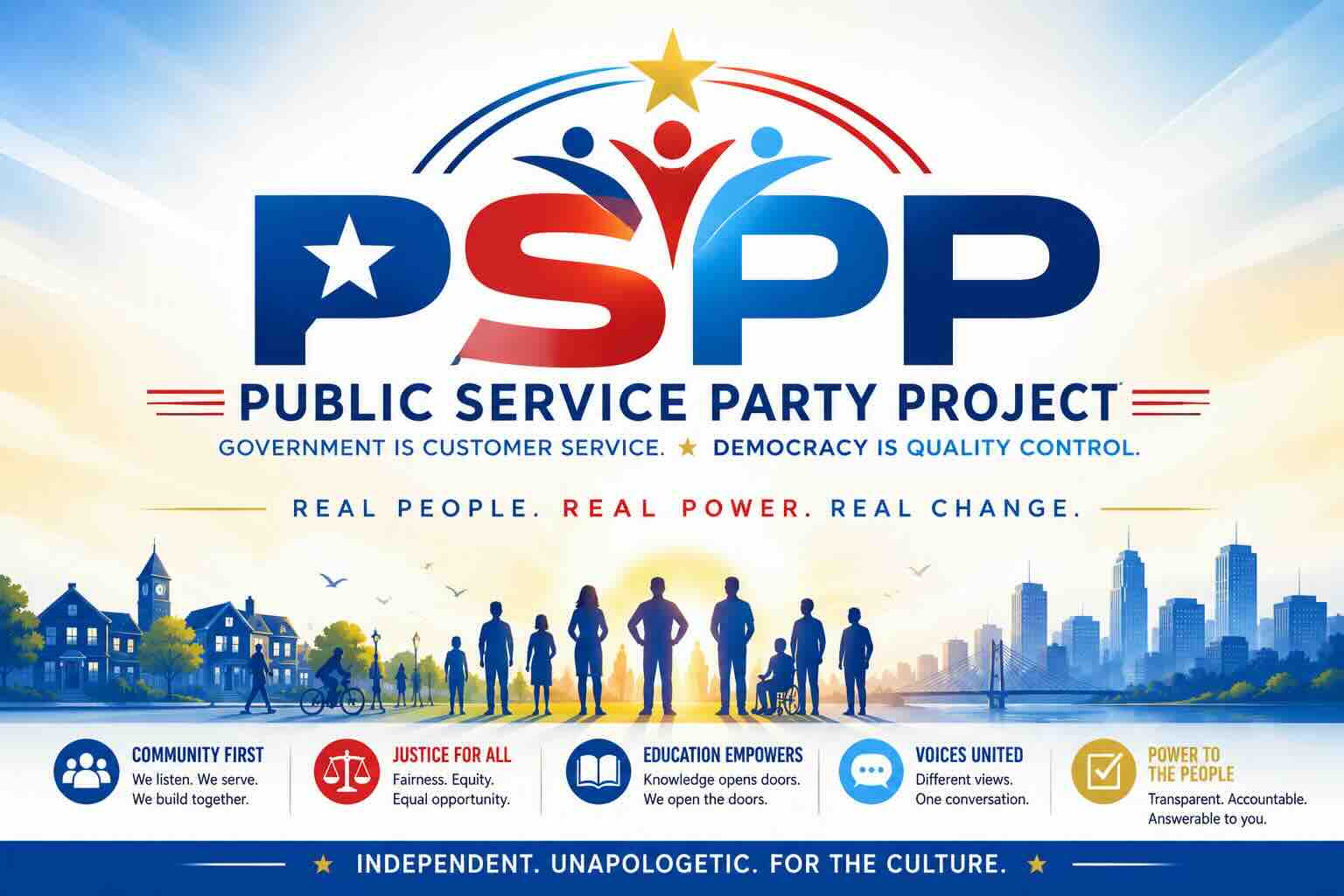
Government is customer service. Democracy is quality control.
Why local government matters.
The daily experience of government is usually not abstract. It is close, practical, and personal.
It is the road that does not get repaired. The school meeting nobody can follow. The housing complaint that disappears into a system. The business permit that stalls for no clear reason. The public notice nobody sees until it is too late. The bus route that changes without meaningful explanation. The sanitation issue that everyone complains about and nobody owns.
This is why the Public Service Project begins with practical public administration, plain-language systems, and measurable service. National politics may dominate attention, but local government often shapes daily life first.
If public service can be repaired locally, it can become visible again. If it becomes visible, people can believe repair is possible.
This is not a campaign launch.
Not yet. Maybe not ever. This is a civic thought project first.
It is a question.
What would government look like if service came before party performance?
It is a framework.
The Public Service Test gives people a practical way to evaluate whether systems actually work.
It is an invitation.
People do not have to agree on everything to demand clearer, more useful public service.
The reason this exists is simple.
It exists because people are tired of being talked at by systems that do not listen.
It exists because public service should not feel like begging.
It exists because disagreement should not make neighbors useless to each other.
It exists because a better standard is possible:
Did the people receive the service they paid for?
If that question makes people uncomfortable, good. It should.
That discomfort is where repair begins.